Wednesday, 27 May 2015

Bikes: The Takeaway Test

I have a secret to tell you: I'm quite a lazy person. The fact that this is the first blogpost I've written on here is probably a bit of a giveaway but it probably ought to be stated outright occasionally, to acknowledge one's own failings.

Advocating for cycling in Scotland (or indeed anywhere on these islands) often comes with a bit of doctrinal baggage - people make certain assumptions about your beliefs, preferences or lifestyle that they wouldn't necessarily otherwise make. I'm not a vegan*; I sometimes drive a car; I take long-haul flights biennally; I rarely contribute to charity; I pretty much loathe maintenance, particularly of the bicycle variety; I admit to a fondness for nice clothes and am not prescriptive enough about where they are sourced from or who might have made them. Moreover, I have a weakness for takeaways and beer, which has to be indulged at least once a week.

I recently bought a new bike - indeed, the first bike I have ever bought myself with the fruits of my own labour. Prior to that, bikes that came into my possession were either gifts or hand-me-downs from my Dad. Prior to taking the plunge and given that I was going to be spending what amounted to a fair wodge on it as well as being my primary mode of transport to work, I tried to approach it in a rational, sensible manner, as opposed to pointing at the one with the shiniest wheels or the raddest paintjob.

Therefore I needed to create a set of criteria for what I wanted and tried to find a bike that would tick as many of the boxes: I knew it had to be utilitarian, ergonomic, and relativel hassle-free. But what do these terms really mean in practical terms?

So here's a simple gambit I came up with: could my bike replace my weekly takeaway run?

To elaborate a little, in order to be of truly practical use, the bike needed to be able to get me to the takeaway shop and allow me to park outside, collect my dinner and a six-pack of beer then head home, all a similar level of fuss and prior preparation that I currently made with a car.

With that in mind, here's the bike I eventually went for:

This was when I first got it - I've angled the handlebars downwards since then

A Workcycles FR8 Dutch cargo bike - hub gears, rear coaster brake, front roller brake, fully enclosed chainset, double kickstand, internal rear lock, front and back dynamo-poowered lights, oversized front and rear racks and a crate.

And here it is laden with...

Beer, jam, scones and clotted cream

["a well known purveyor of fried chicken"] bucket and ...erm... a ten-pack of toilet rolls

I can also confirm that I've completed the full Takeaway Test as well. As expected, the bike passed with flying colours:
  • virtually zero prep required prior to leaving - I just pull it out of the close cupboard and off we go
  • I can wear the same clobber as I'd wear if jumping into the car - the enclosed chain means I don't even need to tuck my trousers into my socks
  • the bike is comfortable to ride, with its fat wheels, expansive mudguards and upright sitting position
  • Having a coaster brakes frees up one hand, meaning I can carry an umbrella if it's raining (or at least, hold my hood up)
  • I am okay leaving it parked out in front of the shop, due to the internal rear wheel lock - no having to hunt about for somewhere to chain it
  • I also don't need to worry about taking stuff off - the lights are fixed on and the crate is cable-tied
  • the crate is more than sufficient for carrying both the beer and the dinner home (I've yet to try a 14" pizza on the rear rack)
  • having the  kickstand means that the bike can be free-standing whilst fully laden - handy for getting back inside when arriving home
  • Maintenance is low - I don't need to use a water expellant after every journey in the rain, because most of the important parts are enclosed
Whilst my "Takeaway Test" might seem a bit frivolous to you - I think there's a valid point to be made here. As I said at the top of this article, I am naturally lazy. The weekly trip to the takeaway was one of a few short car journeys I used to make, mainly because it was inconvenient to do so by bike. With the new bike I have managed to eliminate that journey, amongst other ones (e.g. the supermarket run, the visit to friends or to the pub). Unfortunately, as I've documented in this forum thread it wasn't a particularly straight-forward way to get a bike that would pass the test - I think it pretty unlikely most people could be bothered to follow through with the same sorts of effort.

If advocates and campaigners are serious about making cycling a mainstream activity, we need to appreciate that it must fit around people's lifestyles; whether or not you approve of those particular choices is neither here nor there. That goes from there being convenient, safe, direct routes to the places people want to go, right through to the kinds of bikes people buy and what they come equipped with. If we get to a point where people can do their own "takeaway tests" without much effort, we'll finally be making some progress.


(*) although I recognise that future generations - if our civilisation lasts that long - will likely look on our society's consumption habits and animal welfare record in much the same way we currently regard our own forebears' prediliction for human sacrifice and slavery.

Saturday, 6 December 2014

Passing the Test...

"She's passed her driving test!", my partner said to me last week. Her younger sister Jenny* had been taking lessons for several months and had failed her first attempt a few weeks prior.

"Great news," I responded, gritting my teeth slightly as I said so, "I'm made up for her".

For the avoidance of doubt, it's not that I grudge her the acheivement. Passing the driving test is, for many people - especially those not academically-inclined - one of the only times they will attain a valuable, universally recognised qualification since completing secondary education. The simple boost to one's self-esteem shouldn't be discounted either: despite falling levels of ownership, particularly amongst the young, driving remains a key life skill, representing freedom, independence and self-reliance.

In my own case, I started taking lessons at a time when circumstances in my life seemed quite bleak - coming on the back of a failed long-term relationship, a still-born post-academic career and the prospect of festering in no-prospects, minimum wage job. Thus, obtaining a driver's license was - alongside getting a new job and leaving home - a transformative and empowering experience, helping to kick-start both my life and career. Doors open for you; distance and time shrinks; your life stops revolving around bus timetables or the eternal patience of parents; and if (like me) you get a van, you find yourself in demand as your friend's and family's de-facto removals person - all of a sudden, you've become useful.

The problem is that none of this comes for free. Getting regular access to a vehicle also coincided with not insignificant weight gain on my part - I went up two trouser sizes in as many years post-qualification and have never gotten back down to my optimum weight ever since. All those lessons weren't cheap and neither is fuel - just keeping my old jalopy on the road took a fair old chunk out of my disposable income. I still shudder at the memory of parting with the best part of £200 for vehicle recovery after a midnight breakdown on M8.

Then there's the the longer term consequence of driving: its difficult to stop using the car, even if other options are available. Where you might once have jumped on a train or a bus for a short journey, now you inevitably take the car - why risk your new-found skills deteriorating? Thus one ends up locked in a cycle of continuing (and often unnecessary) car dependency. Lastly, you become a constituent part of the bigger problem -  yet another single occupancy vehicle amongst the morass of traffic clogging our arterial routes, choking our air with noise and toxic fumes.

Jenny works for a supermarket just over a mile from she lives in the south-side of Glasgow. She works the night-shift, gathering the various items people have ordered online for delivery later that day. As one might expect, it pays marginally better than a daytime equivalent. The problem is of course getting to work - public transport is either patchy or non-existent when she needs to commute. In addition, she (understandably) feels fearful of walking the 25 minutes from her home to the shop, as the route passes through an area relatively high in crime and where a number of attacks and sexual assaults on women have taken place even within the last few months.

Up until now, she has depended on friends, colleagues or her parents for lifts to work, with the occasional recourse to expensive taxis if need be. Now that she can drive, Jenny has shelled out for a little pre-owned Fiat 500, for which she'll pay upwards of £115 per month, plus tax, insurance and maintenance costs - a significant outlay for someone of already modest means - to make that 1.2 mile journey every day. I doubt she'll do over 5000 miles in a year. In a sense, she is now in the curious position of working a job at unsociable hours in order to make the extra money required to pay for the car to get her to work during those unsociable hours!

The above absurdity simply highlights the fact that, try as governments of all levels might to "encourage" people onto bikes, cycling is neither a realistic option nor even something that would occur to her (or many others in similar positions) as a feasible alternative. Her sister's boyfriend might cycle to work, but he's a weirdo - only misfits and cranks cycle after all...Joking aside, the roads of Britain are just too unfriendly, unwelcoming and dangerous in appearance for the majority of people to envision using a bike for anything useful like commuting.

Surely something is wrong with our transport system if a young woman feels (for whatever reason) that she is obligated to drive a distance which is self-evidently cycle-able in under 10 minutes. It's all very well for me to advocate for cycling as a force for the public good but when it comes to the rational decisions of individuals regarding their safety and convenience in the current transport environment, I cannot in all good conscience criticize her for making the rational and informed decision to become a driver.

The only bone-fide method that's proven to get people out of their cars and onto bikes in significant numbers anywhere in the western world is to build a high quality, comprehensive, well-connected network of cycle paths and other cycle infrastructure such as exists in The Netherlands. In the mean time, until the vexing question of how to persuade people like Jenny to cycle instead of driving can be answered, all efforts by governments (local and national) to get more people to travel in an active manner are doomed to failure.

(*) not her real name.


Sunday, 12 October 2014

Eglinton Street - Observations on a Late night walk home

A (slightly blurred) picture of GCC's idea of "place"

I was out in Glasgow last night and faced that classic weekend post-midnight dilemma: how to get home? Scotrail inexplicably stop train services from Central to my nearest station at 11:20pm; I have spent enough weird nights on unreliable late buses to know they should be avoided (specifically the last stop on Stockwell Street a.k.a. the twilight-zone of stops); lastly, I have developed a not entirely irrational but nonetheless prejudiced aversion for black taxis.

Thus it was that opted to walk the four miles home, although thanks to a recent Glasgow's most recent public transport innovation, I gave myself a head-start by using the bike-share from Charing Cross to Bridge Street (a clear justification for a further expansion of the scheme southwards).

My route home to Crosshill took me along Bridge Street to Eglinton Toll, passing under the notorious M74 extension. My new daily commute home takes me along this route every day by bike, where I observe a significant number of people on foot - indeed, I suspect more than those who feel able to choose cycling. The picture at the top of the post is perhaps a little unclear, therefore here's a street-view image of the same cross-roads:


View Larger Map

If you rotate the view, you'll notice a few things:

  1. none of arms of the junction have pedestrian crossing facilities - there are admittedly dropped kerbs and a refuge on the Kilbirnie Street arm - but when traffic is busy, there's no formal method for people to stop traffic
  2. There's a huge expanse of unnecessary paving on the corner 
I suspect the former point is a legacy of the pre-existing arrangement, but it seems inexplicable that this wasn't revisited. The construction of a massive, almost unprecedented fly-over, crossing three railway lines and at least three roads in a single span, as well as the impact on a number of nearby homes and businesses surely invites a radical re-think of the entire junction? As per J1A, a relative clean-slate has been squandered.

This leads onto the latter point - what is the purpose of this extended corner and, in particular, the pretty but entirely pointless installation of lights embedded into the wall? I expect that both the paving and the lights will have been implemented in some vague attempt to inject this area with a sense of "place". I can't think of many better recent examples of this misguided and inconsistent policy.

The problem of course is that this area has an inherent movement function - there is no "place" here and there likely never will be. Try as they might, it isn't realistic for GCC to expect people to want to spend any time on this particular corner. People - be they in a car, on a bus, bike or on foot - are going to pass through the junction as quickly and efficiently as they can. And yet, even if you accept the apparent desire to create "place", they make it as hard as possible to actually reach it, with the poor crossing solution.

Now you might say this is just one junction on one street, why the emphasis? This junction sits at a strategically important point, being roughly about halfway between the city centre and Queen's Park -  the junction thus represents a major gateway between inner Glasgow and the outer residential areas of the south-side. And the message from GCC seems as (confusedly and erratically) clear as ever - walk here if (you must) but hey, there's lights and lots of paving! Isn't this a nice place to hang out? Perhaps at some point in the past it was - indeed, the Gorbals has a long been home to thousands of people. But then they decided to demolish most of it, and laterally they decided to build a large urban motorway right through it - with all the best will in the world, the ship labelled "place" sailed some time ago.

The treatment of this junction should thus inform our view of the approach of Glasgow's urban planners when designing in future; for example, the new civic square. Namely, the lack of appreciation about what makes a "place" versus somewhere with a primary movement function - it doesn't matter how many pretty lights, nice paving stones, benches or frescoes you throw at something, it won't mean anything if you fundamentally misidentify it's true purpose. (Mark Treasure has a good term for this: Placefaking)

In my view, GCC would be more honest and provide a more useful solution if they concentrated their efforts on making the junction more easily traversable by both people on bikes and people on foot - and that's it.


Monday, 6 October 2014

Shawlands Cross - Civic Square Consultation

Shawlands Cross - Civic Square Consultation

Prompts to do GCC's job for them
After some judicious prompting from utility cycling veteran Byron Silver and a further blog-posting on Glasgow Cycle Forum by resident reader-of-interminably-dull-planning-documentation Darkerside, I decided to make my way over to the grand old Langside Hall to take a look at their open consultation for the proposed new civic square - a key part of the so-called town centre action plan for Shawlands.

Background


In a previous blogpost, I've briefly covered this area, although not in particular detail. This is perhaps due in part to the Hall being set apart from the road by fences and it being typically shrouded for a large part of the year in thick green foliage. It thus despite its handsome façade and classic (albeit faded) Victorian interiors, it remains at present a peripheral and somewhat anonymous feature in the psycho-geography of the area.


The consultation aims to create a new community space, anchored by the Hall, with the aim of developing it into some sort of "cultural hub" (to use the modern parlance), as well as providing a "gateway" to Queen's Park. Unlike consultations I've attended before, there isn't an actual concrete set of proposals yet, and consultees are being asked to fill in some of the answers themselves.

The most striking (and perhaps most concerning) aspect of this consultation is how open-ended the proposal really is: as stated above, almost nothing appears to have been planned up-front, other than the vague concept of opening up and developing the grounds of Langside Hall into useful public space. Indeed, the only element of the design which appears to be close to solid is the mooted removal of the left-turning junction by-pass, which currently serves mainly as a over-sized taxi rank (and erzatz social club for their drivers).


Touchy/Feely


This customer-focussed, almost do-it-yourself consultation strongly suggests that it's a different team or department in GCC from the one that usually implements infrastructural changes (namely, "here's a design: take-it-or-leave-it"), which despite appearances may be a good thing. There's an awful lot of discussion in the documents about "place" and "setting", hence the array of images of turf, neo-abstract expressionist sculpture, photogenic pebbles and brightly-dressed kids doing handstands in water fountains (well, perhaps I made that last one up!).

With that said, even with my most sceptical curmudgeon-y face on, I couldn't help but grudgingly admire some elements of what's being attempted here - one wonders if the exerable design for the new Sighthill development featured a similar event. Aside from the meat-and-potatoes consultation survey forms, observers were encouraged to make notes and add comments to the displays themselves - you might be able to see from the images above there are post-it notes attached to the boards. Additionally, a large scale map of the area was posted to a table with tracing paper provided, to encourage people to submit their own sketches.


No doubt they'll call this process "crowd-sourcing" a design but the approach betrays the fact that the proposers don't really have a clue what the square will look like and what it's ultimate purpose should be; a situation not helped by the slightly awkward offset orientation of the hall relative to the cross, as well as the copious number of mature trees which will presumably have to be clear-cut to make way for any landscaping. Then there's this mooted "gateway to Queen's Park"; a laudable aim somewhat undermined by the inconvenient presence of a five-a-side football complex and a bowling green immediately behind the Hall - both of which have been in the park for a considerable period of time and neither of which looks to be moving any time soon.

Over-riding all of this is a major (if not fatal) flaw in the narrow terms of reference for this proposal: they aren't going to deal with traffic.

Traffic


The cross itself consists of two intersecting roads: Langside Avenue/Minard Road and Pollokshaws Road. The former is a small part of the B768, an orbital route bisecting the south-side, stitching together Rutherglen, Toryglen, Mount Florida, Battlefield, Langside, Crossmyloof and ultimately Dumbreck, Bellahouston and Ibrox. Pollokshaws Road is of course both a constituent part of the old A77 Kilmarnock Road and an important tributary of the B769 Thornliebank Road. 

Thus both are currently major commuter routes for private motor vehicles and buses passing through from the wider south-side and beyond; note my emphasis. Despite what local businesses in Shawlands might think, very little of this heavy commuter traffic actually stops off there. As my fellow forum user Dez Cartez has said to me in the past, it's going to be very difficult to entirely remove through traffic from Shawlands, but I don't think it's an impossibility to make a sincere effort to reduce it. 

A Diversion


Glasgow-based readers might recall during the mid-1990s the mass of public dismay and anger caused by the extension of the M77 motorway through Pollok Park; anger soon boiled over into direct action and protest (indeed, the creation of a temporary "Pollok Free State" - impromptu camps placed in the path of the diggers). Given all the hassle and strife that was creating (resulting in the sitting Tory MP losing his seat at the '97 election) a big part of the impetus for forcing the construction through was to re-direct commuter traffic - particularly that coming from Newton Mearns and Giffnock - away from the A77. Somewhat counter-intuitively, this in and of itself is not necessarily a bad idea. 

Indeed, it fits into the strategy for segregating traffic modes known as unravelling - namely separate motor vehicles, bikes and pedestrians by providing them with differing routes such that they rarely coincide. There's a quid pro quo here: provide car drivers with a safe, fast, convenient route of their own into and by-passing the city (namely, the motorway or the inter-urban trunk road) but at the same time reduce, re-direct or remove through routes for them in places where you want people and bikes to be (urban high streets, residential areas). In the case of the M77 (and the recent M74 extension) they built the road, but forgot to remove traffic from the A77, hence the volume of traffic simply grew to fill the space.

It's still not too late to do something radical - it's happened before after all. I'm old enough to remember when Victoria Road extended all the way from Queen's Park to the Gorbals. Then, the unthinkable happened: a staggered bus-gate was designated between Eglinton Toll, Butterbiggins Road and Coplaw Street, turning what was once a busy commuter route into the city centre became a virtual dead-end overnight. Only buses, taxis and people on bikes are permitted to traverse it nowadays. Like diverting a river flow, traffic merely shifted onto the lower part of Pollokshaws Road (away from the cross), or dissipated down a circuitous route towards Cathcart Road, with no major long-term negative effects on either.

Unfortunately this particular intervention failed to significantly grow cycle numbers, mainly because - amazingly - people on bikes don't particularly like to share the same space as fast-moving buses and taxis. It also failed to boost local businesses on Victoria Road because the lower reaches of the street which allowed through traffic were still choked with motors but the point still stands: you can successfully close off routes to traffic in the teeth of predictions of dire consequences.

The A77


The A77 differs slightly from Victoria Road in that - due to the confining nature of the nearby railway line, there aren't too many obvious alternative routes to divert traffic onto. The aforementioned M77 takes a lot of the Mearns traffic, but it's perhaps a little further away for Pollokshaws (X miles to the west, in fact), however there are other more suitable potential trunk routes, like the B768/B769 - both routes generally set back from housing and away from retail centres - if a little imagination and ingenuity is used. Traffic could be routed along Nether Auldhouse Road, or even a circuitous dog-leg route back along the far end of Pollokshaws Road. Perhaps those roads will need widening; an extra lane added here or there, speed limits adjusted upwards. It might even just be a case of making strategic parts of our target roads into one-way streets, ban a left or a right turn here or there; simple measures which provide just enough of faff and delay that it might reduce the flow through the cross. Now admittedly I'm not a traffic engineer, nor have I the experience of modelling traffic flows or predicting where drivers rationally choose to travel. But neither it seems are the designers of this scheme.

Unfortunately, none of the suggestions above - fanciful or not - are on the cards, either in terms of this civic square proposal, nor indeed the entire Greater Shawlands plan. Ironically, by focussing so much on place - namely whether or not pink or grey flagstones provide the right ambience for a street cafe - the very real movement function of the area is being ignored, the latter thus ruining the former.

Kilmarnock Road's future - without bikes?

The picture there outlines the existing plans for developing the rest of Kilmarnock Road - most of it involves re-tarmacing the pavements and removing the raised tables across side roads, in favour of dropped kerbs and cobblestones. There will apparently be an attempt to "de-clutter" the footpaths, which is welcome, as well as an apparent aim to improve the junction of Pollokshaws Road and Kilmarnock Road - with any luck by removing the hated metal barriers and providing crossings closer to pedestrian desire lines. However, there is nothing in these plans for cycling, despite arguably ample width and opportunity to do so.

It is unlikely that once this goes in, further revisions will be made for several years to come. By then, it might be too late for Shawlands - the Arcade might just provide enough of a drag on the area that it brings everything else down. Maybe the continuing gridlock and choking atmosphere will continue to put off shoppers, despite the fancy paving. And unfortunately, we've got to face the possibility that, without a clear purpose and a serious determination to sort out traffic problem, the civic square might become yet another empty, unwelcoming, gradually deteriorating space that people rush past on the way to somewhere more pleasant.

Sunday, 28 September 2014

Clyde Gateway: Part 2

Hello,

It's been a wee while since I last talked about infrastructure. Have been a bit busy firstly with Cycle Hack (which I promise I will blog about soon), then changing jobs.

In July and August Glasgow hosted the Commonwealth Games, which lead to a lot of external scrutiny on the city, and with that a focus on our cycling facilities. There was some fuss over disruption to cycle routes, many of which were closed due to their proximity to games venues; somewhat ironic, given that people were being encouraged to walk, cycle and take public transport.

After much delay, I'm going to finish off looking at the Clyde Gateway, the cycle route that runs roughly from M74 J1A to The Forge Retail Park. Part One covered the section from the motorway up to the junction of Dalmarnock Road - this blog post will cover the roadway up to the Emirates Stadium complex, which includes the Sir Chris Hoy velodrome.

A728 and Dalmarnock Road


This next junction is probably the worst feature on the entire road. A few years ago, I used to cycle this way to Dalmarnock train station to catch a train to Blantyre and I started off using this facility. I quickly realised after 2 or 3 near-misses that I was far safer on the road. Here's why. Take a look at this aerial shot, paying particular attention to the footway on the northern side of the road as it joins Dunn Street:


As before, the pavement cycle path re-joins the road but not into the (relative) safety of an ASL. No, this time the path joins explicitly at a feeder lane for a left turn. In the next picture, you'll see a person on a bike at precisely this point. Now imagine he wants to go straight on, as the cycle path indicates. Then imagine that the car travelling just behind decides to turn left. Who has "right of way"?

Lead up to the "killer" corner - look where the arrow directs motor vehicles
I'm not being facetious here - I genuinely don't know. The cycle path has no give way markings but it's also non-mandatory (as indicated by the dashed lines) therefore it is perfectly legal for other vehicles to cross and drive into. My guess is that vehicles should give way to the left, but I'd say a straw poll of drivers would tell you otherwise.

A left-turning car crossing the (non-mandatory) cycle lane
Bear in mind you have what amounts to a dual-carriageway here. With the lights at green and the shallow, forgiving curve onto Dunn St, most left-turning motor vehicles will take this corner at high speed. Again, cycles and cars are approaching the junction parallel to each other and - despite the road markings - cars will presume to have nothing to give way to on their left and will not be expecting to encounter anyone coming from that direction. By way of contrast, look how much further up the first pedestrian crossing is sited and note that you cross the left-lane at right-angles to the road.

I'll be blunt: this junction is of a completely lethal design which should never have seen the light of day. I can only guess that the only reason there hasn't been a serious incident on this junction is due to the very low numbers of users heading in this direction.


Dalmarnock Railway Station


The roadway here has been radically altered from it's original course. In the picture below, the road used to go directly past the building in the mid-ground, then took a sharp right to the original entrance to the station - there was no "straight on" here per se - like M74 J1A, this is all pretty much brand new road.

They seem remarkably proud of this, don't they?

The station is on the right-arm of the expansive four-way junction - note three lanes of traffic

Yet again, we see our path depositing cyclists into the ASL, except there's a new problem. Now, let's say you're on a bike on the cycle path (just like GCC expects you to be), heading for the station. The lights are at green.

How do you turn right?

The answer is: you can't - and you can't even (legally) use the pedestrian crossing (unless you dismount). You would have to stop in the lane and wait for the red light, then sheepishly roll into the ASL.


The refurbished Dalmarnock Station - Forgive me for suggesting that this design won't age well

An expanse of concrete and aluminium fencing, yesterday
Even if we're being charitable about this awful design there are so many oversights. If the expectation is that most people heading this way will be heading for the velodrome (to the left), why don't they allow bikes to bypass the signals? This is the sort of little detail that makes even rubbish infrastructure vaguely useful.

The Velodrome


The entrance to the complex comes via relatively complex staggered junction consisting of two more cycle-path/ASL combo, the latter having the same green light/right turn problem as at the railway station.

...and yet another left-hook opportunity

If you manage to get to the right-turn, you are presented with this:

The junction at the Entrance to the Velodrome
A dedicated right-turn lane in the middle of the junction - fine, but not really dedicated cycle infrastructure is it? Bear in mind this is the entrance to a velodrome. There has been no real effort to emphasise or encourage bikes here, other than the useless ASLs.

Now granted once you are inside, accommodation has been made for bikes... up to a point. The internal roads into the park do not welcome cycles, particularly by including bike-unfriendly infrastructure such as roundabouts. Now you might argue that bikes are expected to ride on the roadway but it just strikes me as odd that even here, there's no further encouragement to cycle in. I suspect the answer is that they really expect users of the arena to drive there (with bikes on roof-racks or suchlike).


Good quality covered cycle parking...

...but no cycle facilities in the car-park. Remember: this is a velodrome

Even leaving the park sends messages that bikes aren't welcome:

Leaving the velodrome... enticing eh?

Not even a dropped kerb
Now if you take another look at the design of the entrance and the car-park, you notice something odd: if you're a pedestrian, you can actually by-pass this and leave the park by a different entrance.


Let's go back to the picture above, where there's a tan area crossing the road - if you turn left (south) there, there's a pedestrian path that takes you to Kinnear Road, and then back on the Gateway. Why isn't this a cycle-able path? It could easily link up with the (sort of useless) painted cycle paths and would have the advantage of avoiding two junctions. Again, little details that would make a big difference...

Celtic Park

Ironically this sign itself is a hazard
Celtic Park was the venue for the opening ceremony (although oddly, not the closing... nope, me neither). Therefore you might say it provided the first impression many visitors would have to our sports facilities. And to be honest, Parkhead itself is quite good... inside. Outside leaves a lot to be desired. They recently demolished an old listed schoolhouse to provide more room for... car parking. Suffice to say there is no cycle parking within the immediate vicinity of the stadium, although there is quite a lot outside:


More Outdoor cycle parking at the front of the Velodrome
One of the great ironies about cycling to and from the games venues was this: you weren't even allowed to park outside! No really: I'm not joking - presumably they feared bike-borne bombs? Therefore all the above cycle parking built especially for it was ... unused throughout... *sigh*.

London Road a.k.a. the A74 - which separates the Velodrome from Celtic Park - is still a busy, uninviting thoroughfare, despite being rendered somewhat superfluous by the extension of the M74. The only place for pedestrians to cross between the Velodrome and Celtic Park is at the junction here:

Two-stage Toucan Crossing
The paths in the immediate vicinity are shared use - presumably in some vague attempt to cover up the fact that no real effort has been made to accommodate cycles. Shared Use as always just represents capitulation - there's a realisation that 4-lane London Road is horrible to cycle on but a lack of any will or imagination to really tackle it, hence let's just chuck them together with people on foot. They won't mind, will they?

Gallowgate

Gallowgate is one of Glasgow's oldest throroughfares and is one of the major routes between the old East End and the centre. The cycle paths continue much as they have on the rest of this route - paint on the pavement ending with an ASL.

Strangely, this is the best (and most farcical) element to the Clyde Gateway route: it doesn't actually go anywhere. No really: it basically fizzles out at the Forge Shopping centre and melts into Shettleston Road - it doesn't link up with the motorway as one might expect it to (well, not until about 4 miles further east at Ballieston). There's one last sting in the tail though.


As you can see, we have a repeat of our killer left-hook scenario, whereby left-turning traffic cuts across the path of straight-on bound cycles. In addition, you have a complex series of roundabouts and junctions to provide motor access to the Forge Retail Park - clearly it would never occur to anyone in charge that people might like to cycle to the shops - particularly in the East End where few residents have access to a motor vehicle.

... and that basically concludes our tour of Glasgow's (almost) newest and finest(sic) cycle infrastructure. Bear in mind readers: this is what Glasgow does with a virtual blank slate and generous external funding, all in advance of a once-in-a-lifetime international sporting spectacle which supposedly had the aim of kickstarting the east end's recovery on the way to better health outcomes. I can think of no greater indictment of GCC's incompetence, misappropriation and downright dishonesty; if not for Edinburgh's cock-up with their tram.

Sunday, 15 June 2014

UK Women's Cycle Forum

On Saturday I made a rare trip across the central belt to our eastern neighbours in Edinburgh to attend the inaugural UK Women's Cycle Forum - the first of it's kind in Britain (unless someone can prove otherwise!). You might say to yourself "hang on, aren't you male?", the answer to which is "of course"*, in which case your next question might legitimately be: "why did you go to a cycling forum for women"? That's a good question, and one I probably can't adequately answer, other than to say "it sounded interesting".

To expand a little: in the last few years, I've been reading more about the politics of feminism; everything from the Patriarchy and masculine hegemony, Fourth Wave and Intersectionality, to the more radical approaches of the Separatist movements**. I don't really know a good reason for me to be interested in this other than being a person living in the modern world; I believe you have an obligation to keep yourself informed and to ignore the female perspective is to miss half the picture. I was brought up in the 80s and 90s in a single parent home by my Mum (although Dad was around). I don't think my mum is "radical" with a capital "R", but she is one of the baby-boomer generation who went to college and carved herself a career in special needs education, all whilst maintaining a household with two kids and assortment of pets. I've always been surrounded by strong female figures, including my sister, my maternal grandmother and aunts (formidable people who all went onto senior roles in their chosen fields). In addition, we were always brought up with a sense of social conscience and an awareness of our privilege. But I dare say whole swathes of men my age had similar upbringings who don't know their Dworkins from their de Beauvoirs.


Perhaps a more pertinent question might be: "Should you go to an event aimed at women?" Well, that's another point I don't really have a good answer for. Part of the motivation for the organisers in creating the event was the lack of representation for women at cycle-related events. There aren't many dedicated spaces for women in the cycle world it seems and it might seem churlish for men like me to insist on being involved at some level. In mitigation, I haven't been at this cycle advocacy game for very long and - other than Pedal On Parliament - I'd never been to anything similar; the forum seemed like a good opportunity to get involved in the conversation in some way, although I recognised the limited contribution I could make to it. I saw my "role" (in as much as I had a role) was to listen and to understand. In addition, the organisers had indicated that "all were welcome", it was only a fiver and food and drink were being provided (!) - what's not to like? I think the only circumstance where I'd have considered declining would be either if it denied access to other women (through a shortage of tickets) or if other attendees felt uncomfortable discussing issues around men. I certainly did not get the impression that I was not welcome, despite some gentle teasing by the hosts! :-)

Getting there

Given my previous problems getting to Edinburgh, I was determined to make it through on the bike. Interestingly, just getting to the venue presented some of the problems we all face. My train arrived at Waverely around 20 past 5 on Saturday afternoon - peak weekend traffic time, with Princes Street being filled with tourists, shoppers, buses, trams and taxis (so many taxis!). The area around the junctions with North Bridge and Leith Street is particularly bad, with narrow footways on the southern carriageway, taxis and coaches loading and unloading outside The Balmoral Hotel and a gaggle of pedestrians laden with suitcases and shopping bags. Given that I'm usually a positive road cycle user, I was surprised at how intimidating this small stretch of Edinburgh (Scotland's "Cycling City", remember) really is - I ended up walking my bike halfway down the St. James Centre before I felt confident enough to take to the road.


View Larger Map

After going through the two busy roundabouts at the top of Leith Walk and a short jaunt up a be-cobbled hill, I arrived at the venue, Edinburgh's "Ukranian Club", replete with yellow and blue flags and ambiguously-signed toilets (люди or жінки?).


View Larger Map


The Panel

I'd arrived a little early, helped myself to a complementary Irn-Bru and picked my seat in the middle of the room by the wall, trying to be as inconspicuous as possible (quite hard for a 6'3" bloke with a slightly scruffy beard). As the room filled up, it became clear that there was a fairly broad spectrum of people - there were young folk, more mature people as well as some mothers with kids and handful of men, most of whom seem to be with female friends or partners.

The panellists lined up behind the desk at the front and were prompted to introduce themselves and to talk about their expertise, passions and (varied) experiences with cycling. All of the panellists gave superb introductory speeches, although the highlight for me was probably Sue Abbot's (a.k.a. Freedom Cyclist) sinister, absurd but hilarious telling of her travails with the Australian justice system over her refusal to adhere to their moronic mandatory helmet law. 

Groups

Thereafter, everyone was encouraged to circulate around the room and form loose groups, to which members of the panel were assigned individually. I sat in on the small group that convened around Jayne Rodgers, a CTC officer who works with and advocates for the needs of disabled bike users. We were joined at the group by a woman who has some form of neuro-muscular condition and who is a trike user. It was a really eye-opener to hear of her experiences as well as the great, useful work Jayne is involved with. We discussed the problems with many cycle routes which form unnecessary barriers to disabled users - bollards, fences, A-gates - anything that reduces the effective width of the path and therefore excludes trikes or quads (incidentally, the variety of cycles that can be provided to meet people's needs is startling - it's a travesty that these aren't more widespread). We also discussed the merits of using cycles compared to other mobility aids such as mobility scooters and wheelchairs. I was reminded of As Easy As Riding a Bike's recent blogpost about mobility, and how dutch-style infrastructure helps many different types of road users, including people on bikes.

Indeed, it was striking the apparent consensus in the room regarding the need for high-quality, dutch-style separated infrastructure as the clear way forward - I wonder if we would get the same level of agreement at a similar event with a majority male presence?


Nosh and Networking

After the group discussion ended, we got down to the proper business of the evening, namely the buffet! You can tell its a posh do when there's cheese on the go. This also precipitated the main part of the event, the post-talk networking. Being a little introverted, I'm often a bit wary of this sort of situation, and I'll tend to move to the back of the room - I think mainly because I'm afraid of being found out as a slightly dull person without much to say. As such, I probably only have myself to blame for not fully engaging with the panellists, even though I was keen to hear more from the likes of Rachel Aldred, and Jo Holtan from Cycle Hack, with whom I'll no doubt speak to next week!

(I was however approached by Lee from the City Cycling Glasgow Forum who revealed that she reads this blog, which was rather gratifying - I have at least one reader!)

Without doubt, the event was a resounding success. With that said, I have a couple of points to make: 

Q and A?

I think the event maybe missed a Q and A element. I knew the format was fairly open, but I had expected something akin to "Question Time", with the panel fielding questions from the floor. I guess there just wasn't time for this - the group discussions took up the majority of time and as I've said above, this was in the end more of a networking event.

Scottish Representation

Okay, it was admittedly called "The UK Women's Cycle Forum", but I felt it was notable that there weren't many Scottish accents on the panel; Claire Connachan from Belles on Bikes was the de facto "token" Scot :-). I think this is more a comment on the state of cycle advocacy in Scotland than on the efforts of the organisers - in my (limited) experience, there are a lot of non-natives who seem to be driving things north of the border. I wonder if this is just my impression or if it's genuinely reflective of reality. Do we need others*** to get a better perspective of how cycling could be?

Minority Representation

I was really pleased that there wasn't solely white faces in the room, but I'd be interested to know how people from different races and backgrounds could be encouraged to come along to another forum. I live in Govanhill; quite a diverse area (for Scotland), with concentrations of different immigrant populations from Ireland, South Asia and Poland as well as recent arrivals from the Roma communities of Slovakia and Romania.

Car usage appears to be quite low amongst the latter groups, particularly the Roma, with a lot of people relying on their feet to get around. Despite the name, the area is pretty flat and features many quiet, mostly non-through route, residential roads and a lot of local shops and businesses to visit; it therefore should be quite good for cycling about in and yet I can't recall seeing anyone other than the children of these communities on bikes. What are the barriers for these women? Is their experience substantially different to their (white) peers? Would they be interested in giving cycling a go if given the opportunity? I'm genuinely not sure how best to approach this to be honest - but it's worth asking the question.

I should stress that these are small points of order and shouldn't detract from the excellent work done by the organisers, the panellists and the participants. I hope this will be the first of many such events - and I'll be happy to turn up again, even just as the token bloke with a beard.

(*) weekday evenings and weekends excluded
(**) Admittedly, this mostly involves "reading about it on Wikipedia" - I don't claim to be a particularly dedicated scholar!
(***) I don't want to come across as a Little-Scotlander here - in my view everyone should have the freedom to be wherever they want to live. I probably should point out that my father is an "other" too, being originally from Sheffield but who has lived in Glasgow for most of his adult life and still speaks with a yorkshire accent - at what point are you considered "native"?

Thursday, 5 June 2014

Response to East Dunbartonshire Council's Bears Way Scheme

This blog is my response to the above consultation as referenced here:
Firstly, I have to commend EDC for their vision. I am encouraged that there appears to be a recognition that separating modes of travel is vital to increasing the number of people cycling, by improving both actual safety and (crucially) a subject sense of safety - the latter is particularly important for encouraging demographic groups such as children and the elderly who are currently excluded from cycling through fear of hostile road conditions.

I'm pleased that priority for the cycle path will be given over minor side roads - this is particularly important as it:
  1. Signals that cycling is considered a serious form of transport, rather than something associated with leisure
  2. Facilitates journeys along the path by minimising interruptions by give ways and junctions - cycling is most suited to continuous travel conditions at steady speeds
  3. Will encourage potential users onto the facility who, under normal circumstances, would forgo the use of cycle infrastructure which typically impede progress
Combining the above with the raised tables for pedestrians at junctions, a clear message is being sent that active travel methods have priority at these junctions.

I also welcome, in principle, the concept of continuing the protected cycle path in proximity to bus-stops. Often with poor quality implementations, cycle lanes give up at "difficult" points like this, thus forcing cycles into conflict with buses; two forms of transport that are least suited to mixing.

To reiterate, I approve of these measures - EDC have the opportunity here to provide good quality facilities that outstrip the ambition of neighbouring councils. With all that said, I have some comments that I'd like you to consider:

1. Bus-stop by-pass

The Royal College Street bus-stop cited in your document is an inferior example to follow. It puts people on cycles into direct conflict with people boarding or alighting buses. There is only a narrow strip on which to stand and the bus shelter is on the wrong side of the cycle path. As such, it has been necessary to force cycles to give way, thus impeding progress. In addition, elderly, disabled or passengers with pushchairs may feel uncomfortable crossing the path at this point, even if they have notional priority.

This potential for conflict should not be necessary with a well-designed scheme. Much better examples exist in the UK already, specifically in Brighton (see below):
A Bus-stop bypass in Brighton with plenty of space for passengers - first class

http://www.cycling-embassy.org.uk/photos/good-cycling-facility-of-the-week/good-cycling-facility-of-the-week-5th-june-2014
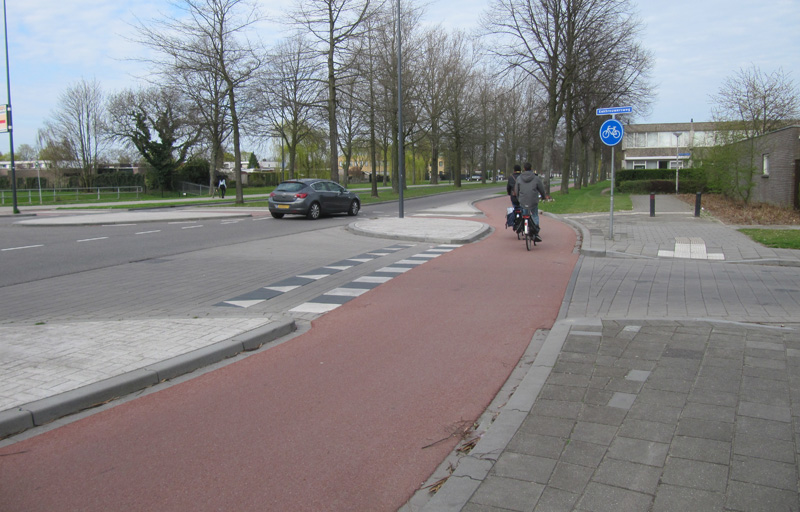
As you can see, the (wide) cycle path diverts around the rear of the bus-stop and the shelter. Pedestrians will still have to cross the path, but the crossing takes places away from the actual stop itself, thus completely avoiding the potential for conflict with passengers on a recently arrived bus. The effect is similar in function to existing unmarked road crossings with pedestrian refuges - an arrangement most users will already be readily familiar with.
This sort of facility is very common in the Netherlands. For further continental examples, please follow this link:

http://www.aviewfromthecyclepath.com/search/label/bus%20stop%20bypass
I appreciate that it may be that lack of space behind the bus-stop might be cited as justification for your approach here, but it would be worthwhile considering narrowing the road and pushing the bus-stop further into the lane, as is commonplace for other crossing points. Alternatively, it might be necessary to relocate the bus-stop to a more suitable location. It also might be easier to implement a scheme on a uni-directional path (see point 3).

2. Junctions with Minor Roads

As I stated above, giving cycles priority over minor side roads is a major step forward. However, the design used is sub-optimal.
Typical junction treatments where cycle paths cross minor roads in the Netherlands have the cycle (and pedestrian) path divert slighty in order that they cross slightly into the minor road. This means that there is sufficient space for vehicles turning in and out of the road to wait whilst giving way:


For right turning vehicles, this helps in keeping the main carriageway clear and thus removes the requirement for a right-turn waiting lane (as per QCC2). Secondly, vehicles make the turn manoeuvre in two distinct movements - this means that the driver does not have to wait for clear oncoming traffic as well as a clear junction to cross the carriageway. Thirdly, it means that the driver is facing the cycle path at right angles, providing better lines of sight between driver and cyclist or pedestrian and hence minimising the potential for error.

3. Cycle Paths: Bi-directional vs. Uni-directiona

It would be better if a way could be found to keep the cycle path on one side of the road for the whole length of the facility. Indeed, it would be even more worthwhile considering implementing two uni-directional paths on both sides of the road, rather than a single bi-directional path which switches sides. The reasons as three-fold:
  1. It is a more natural arrangement, particularly where the path isn't continuous and cycles are coming from roads which don't have separated paths.
  2. Crossing the road is inefficient and inconvenient - this will be a particularly acute problem if the phases of the crossing aren't optimised to favour cyclists and pedestrians
  3. Width - if the path is heavily used in both directions, congestion could become a problem as there isn't sufficient space to over-take slower-moving riders
Regarding point 2, commuter cyclists will likely not want to use the facility, or will only partially use it if they find their progress is hampered unnecessarily by having to cross at the toucan - alternatively, you might find people will attempt to cross the road against the red signal, thus increasing the risk of a collision.


On that note, the recommended width of paths is as follows (although width recommendations vary with the volume of cycle traffic) - note both below require a 50cm margin between the path and the road:
  • Uni-directional path - 2m
  • Bi-directional path - 3.5-4m
Note that both of these solutions should fit within a single "car" lane. In addition, it is worth nothing that there are ways to resolve conflicts between bike lanes and residential parking - namely by putting the cycle path behind the line of parked cars. This is a common solution in both the Netherlands and in the USA:

(note that is bi-directional path in the picture above).

4. Shared Use and The Roundabout

I can see why this method has been chosen for the top part of the route - it allows users travelling along Main Street to bypass the roundabout entirely. But I can't stress this point enough: shared use paths represent poor quality cycle infrastructure which benefits no-one other than motor vehicles, except perhaps where pedestrian use of the path is negligible in the first place. All shared use paths do is put pedestrians into direct conflict with cycles - the reason why bikes were banned from the pavements in the first place. This creates ill-will between the two user groups, whilst impeding the natural progress of quicker, more nimble bike users (although, the priority at minor roads mitigates this to a degree).
It also avoids dealing with the most problematic element: the roundabout itself. There are ways to upgrade roundabouts to make them safely navigable by bike, particularly ones as large and with as much unused space as this example. Upgrading the roundabout will also extend the usefulness of the facility for those travelling further north along the A81 Glasgow Road. Southbound riders coming from that direction would have difficulty gaining access to the path as a result.
The following video illustrates a number of potential solutions for the roundabout. I would strongly advise giving it a watch:


Alternatively there are a number of examples discussed here:

http://www.aviewfromthecyclepath.com/search/label/roundabouts

If these measures were to be combined with uni-directional paths on either side of the carriageway, it would be possible to travel down either route and through the roundabout without interacting with traffic at all for the entire length of the facility. This would be a major incentive to for all types of cycle user.