"She's passed her driving test!", my partner said to me last week. Her younger sister Jenny* had been taking lessons for several months and had failed her first attempt a few weeks prior.
"Great news," I responded, gritting my teeth slightly as I said so, "I'm made up for her".
For the avoidance of doubt, it's not that I grudge her the acheivement. Passing the driving test is, for many people - especially those not academically-inclined - one of the only times they will attain a valuable, universally recognised qualification since completing secondary education. The simple boost to one's self-esteem shouldn't be discounted either: despite falling levels of ownership, particularly amongst the young, driving remains a key life skill, representing freedom, independence and self-reliance.
In my own case, I started taking lessons at a time when circumstances in my life seemed quite bleak - coming on the back of a failed long-term relationship, a still-born post-academic career and the prospect of festering in no-prospects, minimum wage job. Thus, obtaining a driver's license was - alongside getting a new job and leaving home - a transformative and empowering experience, helping to kick-start both my life and career. Doors open for you; distance and time shrinks; your life stops revolving around bus timetables or the eternal patience of parents; and if (like me) you get a van, you find yourself in demand as your friend's and family's de-facto removals person - all of a sudden, you've become useful.
The problem is that none of this comes for free. Getting regular access to a vehicle also coincided with not insignificant weight gain on my part - I went up two trouser sizes in as many years post-qualification and have never gotten back down to my optimum weight ever since. All those lessons weren't cheap and neither is fuel - just keeping my old jalopy on the road took a fair old chunk out of my disposable income. I still shudder at the memory of parting with the best part of £200 for vehicle recovery after a midnight breakdown on M8.
Then there's the the longer term consequence of driving: its difficult to stop using the car, even if other options are available. Where you might once have jumped on a train or a bus for a short journey, now you inevitably take the car
- why risk your new-found skills
deteriorating? Thus one ends up locked in a cycle of continuing (and often unnecessary) car dependency. Lastly, you become a constituent part of the bigger problem - yet another single occupancy vehicle amongst the morass of traffic clogging our arterial routes, choking our air with noise and toxic fumes.
Jenny works for a supermarket just over a mile from she lives in the south-side of Glasgow. She works the night-shift, gathering the various items people have ordered online for delivery later that day. As one might expect, it pays marginally better than a daytime equivalent. The problem is of course getting to work - public transport is either patchy or non-existent when she needs to commute. In addition, she (understandably) feels fearful of walking the 25 minutes from her home to the shop, as the route passes through an area relatively high in crime and where a number of attacks and sexual assaults on women have taken place even within the last few months.
Up until now, she has depended on friends, colleagues or her parents for lifts to work, with the occasional recourse to expensive taxis if need be. Now that she can drive, Jenny has shelled out for a little pre-owned Fiat 500, for which she'll pay upwards of £115 per month, plus tax, insurance and maintenance costs - a significant outlay for someone of already modest means - to make that 1.2 mile journey every day. I doubt she'll do over 5000 miles in a year. In a sense, she is now in the curious position of working a job at unsociable hours in order to make the extra money required to pay for the car to get her to work during those unsociable hours!
The above absurdity simply highlights the fact that, try as governments of all levels might to "encourage" people onto bikes, cycling is neither a realistic option nor even something that would occur to her (or many others in similar positions) as a feasible alternative. Her sister's boyfriend might cycle to work, but he's a weirdo - only misfits and cranks cycle after all...Joking aside, the roads of Britain are just too unfriendly, unwelcoming and dangerous in appearance for the majority of people to envision using a bike for anything useful like commuting.
Surely something is wrong with our transport system if a young woman feels (for whatever reason) that she is obligated to drive a distance which is self-evidently cycle-able in under 10 minutes. It's all very well for me to advocate for cycling as a force for the public good but when it comes to the rational decisions of individuals regarding their safety and convenience in the current transport environment, I cannot in all good conscience criticize her for making the rational and informed decision to become a driver.
The only bone-fide method that's proven to get people out of their cars and onto bikes in significant numbers anywhere in the western world is to build a high quality, comprehensive, well-connected network of cycle paths and other cycle infrastructure such as exists in The Netherlands. In the mean time, until the vexing question of how to persuade people like Jenny to cycle
instead of driving can be answered, all efforts by governments (local
and national) to get more people to travel in an active manner are
doomed to failure.
(*) not her real name.
Showing posts with label Supermarket. Show all posts
Showing posts with label Supermarket. Show all posts
Saturday, 6 December 2014

Sunday, 1 June 2014
Supermarkets: Morrisons Pollokshaws
Just a quick one. To take advantage of yesterday's glorious weather, I took a somewhat circuitous route* to a not-so-close by Morrisons supermarket at the back-end of Shawlands (or Pollokshaws, to be more accurate). Clearly a bunch of other people had similar ideas, as evidenced by the cluster of bikes surrounding the entrance. Unforunately, Morrisons Pollokshaws' bike parking consists of this:

Yes, that is indeed a grand total of two uncovered Sheffield stands you can see there. The other bike users who arrived concurrently with me had to resort to chaining our bikes to the less than ideal over-sized covered parking for trolleys.
Bear in mind this isn't your typical out of town big-box store - this is an urban supermarket in a fairly densely populated residential part of the south-side. A significant proportion of its customers will be arriving on foot and could potentially travel there by bike, particularly on sunny days like Saturday.
Not great Morrisons!
On a slightly more positive note, you can see the kids bikes in the picture - the top few belonged to a father and his two sons, who took to the pavement as they set off later along Pollokshaws Road - in this environment, who can blame them?
(*) somewhat ironic, given that I'm forever railing against this sort of thing on the blog!
Yes, that is indeed a grand total of two uncovered Sheffield stands you can see there. The other bike users who arrived concurrently with me had to resort to chaining our bikes to the less than ideal over-sized covered parking for trolleys.
Bear in mind this isn't your typical out of town big-box store - this is an urban supermarket in a fairly densely populated residential part of the south-side. A significant proportion of its customers will be arriving on foot and could potentially travel there by bike, particularly on sunny days like Saturday.
Not great Morrisons!
On a slightly more positive note, you can see the kids bikes in the picture - the top few belonged to a father and his two sons, who took to the pavement as they set off later along Pollokshaws Road - in this environment, who can blame them?
(*) somewhat ironic, given that I'm forever railing against this sort of thing on the blog!
Monday, 17 March 2014
Cycle Parking: Supermarkets - Lidl & Aldi
Last time, I looked at the cycle parking provision at Morrison's Gallowgate and Asda Toryglen. This time, it's German discount chains Aldi and Lidl that get the treatment.
As is probably quite obvious from the above text I unequivocally declare myself a fan of both brands (although I have no relationship with them) - I like the smaller scale, the low prices and that I can find pretty much all I need shopping-wise; there's also the coup of including the "mystery middle aisle" (more on that later). As they are so evenly matched, choosing one or the other depends a lot on small details - a specific product, where I am at a given moment, the direction I'm travelling in etc. One of the factors that can have an influence if I'm shopping on my bike are the facilities for me to park.
There are four Aldi stores in Glasgow proper, with several in the periphery of Greater Glasgow, including Rutherglen, Clydebank, Paisley, Erskine, Bellshill, Motherwell, Airdrie and Hamilton. Lidl has a similar spread, although is more firmly established - there are about double the number of stores in roughly the same radius, with at least 12 within the city boundary. I'll look at the closest examples of each. Aldi Rutherglen, approximately 1.7 miles away and Lidl Victoria Road, a mere 0.8 miles distance. It goes without saying that both are easily commutable by bike distance-wise; the road conditions differ significantly though.
As indicated above, Aldi has a the mystery middle aisle, in which can be found a series of seasonal or limited offer stock - a veritable Aladdin's cave of bric-a-brac and pot-luck ephemera, from kitchenware and tools to clothing and electronics. Aldi is notable amongst cycling enthusiasts for its "Crane" range of cycling apparel, which (like much of Aldi's product range) is of decent quality - I have a number of items which I use on a daily basis that have originated here.
Regrettably and counter-intuitively, Aldi Rutherglen lets itself down with bike provision - there is no "official" parking at all.
"But there are Sheffield Stands there", you might say. Yes, there are metal barriers, but these are intended to wrangle trolleys. When full, there is no room - not to mention the danger of the bike being damaged by errant shoppers in a rush to get a trolley. This despite a recent refurbishment of the car-park to add additional spaces (FOR CARS) at the back of the shop.
Other than the railings for trolleys, there are fences near the car-park entrance - exposed and relatively far away from the shops front door. The implication is very clear here - dry trolleys and cars are more important than bikes. It's such a shame that the management (either local or regional) fail to understand this, particularly given that they provide reams of specific "Parent & Child" parking too:
There was a clear opportunity to improve facilities here with the renovation work which has been squandered. This would suggest that someone believes that the way to get more customers into the shop is to provide extra parking, which I believe is a false paradigm. The size of the shop precludes the sort of bi-monthly bulk buying that fits with car dependency. Supermarkets like this and in this area are suited better to more frequent/smaller quantity shops - the kind more suited to pedestrian or customers arriving by bike.
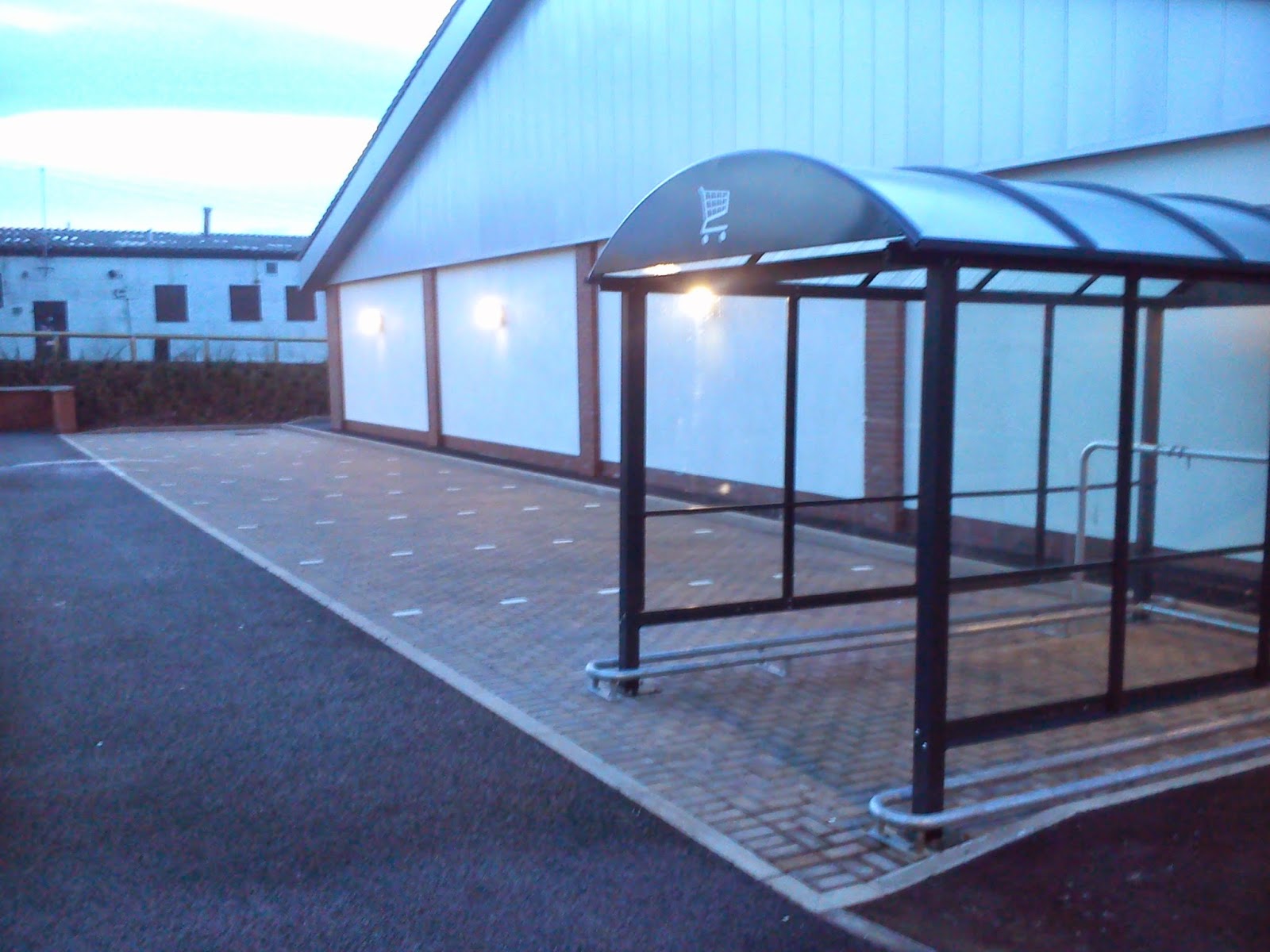
By contrast to Aldi Rutherglen, the bike provision here is streets ahead. Unfortunately the photograph was taken at a time when some work was being done on the roof, hence the cherry-picker parked beside it - but imagine this same scene without it or the (slightly) encroaching Heras fence. There are 8 good quality Sheffield stands - room enough for 16 bikes, which compares well to the limited number of parking spaces for cars. The stands are sheltered from the elements by a purpose-built roof, in other words they aren't sheltered by accident of design - someone has actually gone and designed this facility specifically with bikes in mind.
The shelter is also prominently and conspicuously placed in the small car-park close to the entrance - the trolleys get top billing again (of course!). But its clear that Lidl recognise that their setting - an urban high street on a bus route - is going to get the bulk of its trade from pedestrians and people on bikes, and they've prepared for them. Bravo to Lidl Victoria Road! If only they started selling bike apparel, the choice would be a lot easier.

As you can see, the painted bike lane has long since worn away - the dropped kerb and the faded blue bike sign being the only real evidence of its previous existence - this is a pattern we see quite a lot throughout the south-side. A more useful approach would have been to direct the path away from the vicinity of the bus-stop - 5 metres or so to the right perhaps - and to mark out the path physically with either a drop in height, or a different surface type.
Overview
Compared to long established chains like Tesco and Sainsburys, Aldi and Lidl are relatively recent editions to Glasgow's supermarket retail scene, despite being fixtures of continental European high streets for decades. Although subtly different in service and products, they both share similar traits. They are both a product of German supermarket philosophy, which favours smaller shops in urban settings - as opposed to the UK's love of US-style out-of-town big box hypermarkets - with a focus on providing a (relatively narrow) range of good quality, own-brand products with steady (budget-orientated) pricing; you don't find the profligacy of multi-buy deals common with the so-called "big four" retailers. Efficiency is key, with items being displayed in floor to ceiling packing crates (hence they are in a sense, self-stacking and self-clearing), tills which only open up when required and where customers pack their shopping at tables away from the tills (thus improving the flow rate).As is probably quite obvious from the above text I unequivocally declare myself a fan of both brands (although I have no relationship with them) - I like the smaller scale, the low prices and that I can find pretty much all I need shopping-wise; there's also the coup of including the "mystery middle aisle" (more on that later). As they are so evenly matched, choosing one or the other depends a lot on small details - a specific product, where I am at a given moment, the direction I'm travelling in etc. One of the factors that can have an influence if I'm shopping on my bike are the facilities for me to park.
There are four Aldi stores in Glasgow proper, with several in the periphery of Greater Glasgow, including Rutherglen, Clydebank, Paisley, Erskine, Bellshill, Motherwell, Airdrie and Hamilton. Lidl has a similar spread, although is more firmly established - there are about double the number of stores in roughly the same radius, with at least 12 within the city boundary. I'll look at the closest examples of each. Aldi Rutherglen, approximately 1.7 miles away and Lidl Victoria Road, a mere 0.8 miles distance. It goes without saying that both are easily commutable by bike distance-wise; the road conditions differ significantly though.
Aldi Rutherglen
Note that I'm cheating again by including Rutherglen, which isn't technically Glasgow. Indeed, it's actually part of the South Lanarkshire Council area. However in reality, the town integrates pretty seamlessly with Glasgow, forming a de-facto local business district for this part of the South-side. Aldi is (in my opinion) the slightly "posher" of the two, with better products (for example, the hommous is just that bit tastier :) ). It is also on my commute, hence I'll often pop in for some dinner after work. The shop sits just slightly away from Rutherglen Cross, near the (slightly intimidating) pedestrian subway under Glasgow Road and Rutherglen Main Street. As befits a small urban supermarket, there's a modest car-park, with the majority of customers coming on foot.As indicated above, Aldi has a the mystery middle aisle, in which can be found a series of seasonal or limited offer stock - a veritable Aladdin's cave of bric-a-brac and pot-luck ephemera, from kitchenware and tools to clothing and electronics. Aldi is notable amongst cycling enthusiasts for its "Crane" range of cycling apparel, which (like much of Aldi's product range) is of decent quality - I have a number of items which I use on a daily basis that have originated here.
Regrettably and counter-intuitively, Aldi Rutherglen lets itself down with bike provision - there is no "official" parking at all.
 |
| Trollies and ... erm ... plants are well served |
"But there are Sheffield Stands there", you might say. Yes, there are metal barriers, but these are intended to wrangle trolleys. When full, there is no room - not to mention the danger of the bike being damaged by errant shoppers in a rush to get a trolley. This despite a recent refurbishment of the car-park to add additional spaces (FOR CARS) at the back of the shop.
 |
| Brand New Parking and Trolley shelter |
Other than the railings for trolleys, there are fences near the car-park entrance - exposed and relatively far away from the shops front door. The implication is very clear here - dry trolleys and cars are more important than bikes. It's such a shame that the management (either local or regional) fail to understand this, particularly given that they provide reams of specific "Parent & Child" parking too:
 |
| Couldn't just one of these spaces be allocated for bikes? |
Lidl Victoria Road
 |
| Yay Lidl! |
 |
| The two bikes at the back are posh stainless steel custom affairs |
The shelter is also prominently and conspicuously placed in the small car-park close to the entrance - the trolleys get top billing again (of course!). But its clear that Lidl recognise that their setting - an urban high street on a bus route - is going to get the bulk of its trade from pedestrians and people on bikes, and they've prepared for them. Bravo to Lidl Victoria Road! If only they started selling bike apparel, the choice would be a lot easier.
Post-script
Thought I would note this little enjoinder. Across from Lidl, there's a small example of where filtered permeability techniques can be misapplied if not designed properly. The road here has been blocked off to through motor traffic with large, flat bollards, but there's supposed to be a little cycle by-pass. I say it like that because in reality, it isn't really usable, because of the close proximity of the bus-stop - people (naturally) use the bollards for sitting and tend to congregate on the pavement.As you can see, the painted bike lane has long since worn away - the dropped kerb and the faded blue bike sign being the only real evidence of its previous existence - this is a pattern we see quite a lot throughout the south-side. A more useful approach would have been to direct the path away from the vicinity of the bus-stop - 5 metres or so to the right perhaps - and to mark out the path physically with either a drop in height, or a different surface type.
Sunday, 2 March 2014
Cycle Parking: Supermarkets
As a slight diversion from the subject of the last four postings, I'm going to take a quick look at (tangentially) related issue: cycle parking. Compared to the safety issues related to cycling - junction design, protected lanes etc - parking at your destination might seem like a bit of a side issue; a "nice to have". Whilst I agree with that in principle, I think it's still worth looking at the quality of facility provided for bikes at sites such as retail destinations, public buildings and transport hubs - something I'm going to call "End-point Infrastructure". After all, there's little purpose in having a good quality cycle network if there's nowhere to park the bike once you arrive. In addition, providing parking facilities, like other so-called "cinderella services" such as shower/changing rooms/lockers in workplaces is something that can be fairly easily and cheaply remedied right now, as well as being well within the competence of employers/site owners; something they don't have have to rely on local/central government for.
I'll start by looking at some local supermarkets, as these are destinations pretty much everyone has to visit one way or another at some point in their week (unless you live in some sort of local shop nirvana or are a freegan). I'll add more entries as I come across them, but I'll start with some I've visited recently (and had the presence of mind to take some pictures).
I think by its nature - and without access to statistics like area, customer volumes and number of car parking spaces (I'm NOT going to go around counting them!) - this is going to be quite a subjective evaluation, but I'll try to consider the following dimensions:
* This is my assumption incidentally. Would be interested to hear if anyone has a different perspective
This supermarket is quite a recent edition to Glasgow's supermarket corps (ahem... what's the collective noun for supermarkets? A Rip-off? A Robbery?) - it is also what you might call an "urban supermarket", in that it's located on an old brownfield site in the inner city, rather than being a big box greenfield in the suburbs or out-of-town. I'd estimate that it's probably what you'd call "Medium-sized" - it has a large groceries section but doesn't have the extended section for clothes, electronics or home goods.
It is located on Barrack Street, just off the Gallowgate, about a mile east of Glasgow Cross. The shop sits right across from the famous/notorious Barras Market - a development which will no doubt have depressed the remaining (demoralized) stallholders there. At the same time, it covers an area not well served by food retailers - fresh fruit&veg being particularly hard to find - as well as potentially attracting savvy students in the nearby halls of residence not wanting to be stung by the prices of mini-markets and the Co-op on George Street. The area - known as the Calton - is also one of the most deprived in Glasgow (the UK, even) and has a male life expectancy lower than Bogotá and Baghdad*. Thus, very few local residents have access to a car and I would expect a big proportion of customers will come on foot or public transport. In other words: a location ripe for bikes.
* citation needed
To be fair to Morrison's, they've done a decent job here - a benchmark if you will. There are two entrances to the shop - a main one on Barrack Street and a secondary door by the car park at the back. Each has a row of standard steel Sheffield stands right by the door, with six at the front and a further four at the back - I estimate space for approximately 20 bikes, which seems reasonable compared to the size of the relatively modest car park.The stands are conspicuously located under the well-lit and sheltered frontage, although I suspect given the right combination of wind direction and rainfall intensity they might be a little exposed in some circumstances.
At the very least, it looks as if they've at least considered that some of their customers will arrive on a bike and have prepared accordingly. This is in marked contrast to the next facility I'll look at.
This is my local supermarket, being about two streets away. It is also just across the road from Holyrood Secondary School (one of the largest in Europe) Hampden Park and the Toryglen Regional Football Centre and will be close to one of the proposed bike share stations. Like before, this supermarket could be called "urban" but it shares more in common with out-of-town big boxes - namely, proximity to a motorway junction (M74 J1A) and a huge car park. It's also pretty large inside and includes non-grocery stock - clothes, electronics and homeware on a mezzanine floor. At least it is also pretty convenient for bus routes (the 75 and 7) and Crosshill railway station.
Cycling provision is, to be blunt, fairly poor. You wouldn't know it from the picture but off to the right, there are some sheffield stands - round the corner, near the staff entrance, away from the main doors, out of sight.
There are four* stands here, thus potentially accommodating up to eight bikes, but as you can see, the stands are positioned too close to the wall, making it awkward to access and lock bikes conveniently. The area is reasonably lit, but again its position round the corner makes it feel less secure. You will often find bikes locked to lighting poles round the front, presumably because people don't realise there are stands or would rather keep them in a more public spot. Other than perhaps the wall, there is no shelter from the elements at all - you can see one of the bikes in the picture has a plastic bag on the saddle and for good reason.
What is abundantly clear here is that bikes are - at best - an afterthought. The management here clearly don't expect more than handful of people to come here by bike, despite it being close to an overwhelmingly residential area (including the nearby borough of Rutherglen).
* you can see another three metal stands that look like Sheffields, but these are there to prevent the doors from opening fully - you'd be pretty daft or desperate to lock your bike to them!
That'll probably do for this instalment - in the next post, I'll be comparing and contrasting the local instances of two German discounters Lidl and Aldi, which have surprisingly different approaches to the same issue.
I'll start by looking at some local supermarkets, as these are destinations pretty much everyone has to visit one way or another at some point in their week (unless you live in some sort of local shop nirvana or are a freegan). I'll add more entries as I come across them, but I'll start with some I've visited recently (and had the presence of mind to take some pictures).
Evalution Criteria
In terms of evaluation criteria...Hmmm... this is going to be difficult but I'll try to apply some consistent guidelines. Do we compare like with like? Is it fair to compare e.g. an out-of-town big-box hypermarket versus a high street mini-market? I suspect this will change I look at more facilities.I think by its nature - and without access to statistics like area, customer volumes and number of car parking spaces (I'm NOT going to go around counting them!) - this is going to be quite a subjective evaluation, but I'll try to consider the following dimensions:
- Availability - by this I mean "are there any official facilities at all". Big demerits for "unofficial" parking (e.g. perimeter fencing, light poles, trees etc.)
- Convenience - is the cycle parking close to the door of the shop. This includes "indoors" incidentally
- Number of spaces - are there plenty of bike spaces available, relative to the size of the store
- Security/conspicuousness - I've put these two measures together as they are (to my mind) inter-related, although it could also be applied to the sturdiness/quality of the facility. The more obvious/visible the facility, the less likely someone will be to have a go at nicking your bike
- Quality - related to above. I'd expect a Sheffield stand as a minimum but more kudos for more elaborate solutions. Also includes whether or not the facility is sheltered or open to the elements
- Other - is there something unique about this facility that isn't covered above?
* This is my assumption incidentally. Would be interested to hear if anyone has a different perspective
Morrison's Gallowgate
Location - Open StreetMap |
| Morrison's Gallowgate's rear cycle facilities |
It is located on Barrack Street, just off the Gallowgate, about a mile east of Glasgow Cross. The shop sits right across from the famous/notorious Barras Market - a development which will no doubt have depressed the remaining (demoralized) stallholders there. At the same time, it covers an area not well served by food retailers - fresh fruit&veg being particularly hard to find - as well as potentially attracting savvy students in the nearby halls of residence not wanting to be stung by the prices of mini-markets and the Co-op on George Street. The area - known as the Calton - is also one of the most deprived in Glasgow (the UK, even) and has a male life expectancy lower than Bogotá and Baghdad*. Thus, very few local residents have access to a car and I would expect a big proportion of customers will come on foot or public transport. In other words: a location ripe for bikes.
* citation needed
To be fair to Morrison's, they've done a decent job here - a benchmark if you will. There are two entrances to the shop - a main one on Barrack Street and a secondary door by the car park at the back. Each has a row of standard steel Sheffield stands right by the door, with six at the front and a further four at the back - I estimate space for approximately 20 bikes, which seems reasonable compared to the size of the relatively modest car park.The stands are conspicuously located under the well-lit and sheltered frontage, although I suspect given the right combination of wind direction and rainfall intensity they might be a little exposed in some circumstances.
At the very least, it looks as if they've at least considered that some of their customers will arrive on a bike and have prepared accordingly. This is in marked contrast to the next facility I'll look at.
Asda Toryglen
Location - Open Streetmap |
| Asda Toryglen - at least the trolleys are dry |
Cycling provision is, to be blunt, fairly poor. You wouldn't know it from the picture but off to the right, there are some sheffield stands - round the corner, near the staff entrance, away from the main doors, out of sight.
 |
| Note the night-safe has preferential positioning |
What is abundantly clear here is that bikes are - at best - an afterthought. The management here clearly don't expect more than handful of people to come here by bike, despite it being close to an overwhelmingly residential area (including the nearby borough of Rutherglen).
* you can see another three metal stands that look like Sheffields, but these are there to prevent the doors from opening fully - you'd be pretty daft or desperate to lock your bike to them!
That'll probably do for this instalment - in the next post, I'll be comparing and contrasting the local instances of two German discounters Lidl and Aldi, which have surprisingly different approaches to the same issue.
Subscribe to:
Posts (Atom)